Scottsdale and Phoenix Housing Market Update: June 2026

Inventory across the Phoenix metro tightened again in June, even as active listings nationally kept climbing. That gap is the story of this month. Sellers are cutting list prices faster than almost anywhere else in the country, yet the homes that do sell are closing at prices slightly higher than a year ago. Those two facts sound like they contradict each other. They don't. They describe a market where pricing correctly upfront works, and pricing wrong gets punished fast.
The National Backdrop: A Settled Spring, A Slower Summer Ahead
Nationally, June looked calmer than the spring that preceded it. Mortgage rates held around 6.5% for six straight weeks, according to Realtor.com's June 2026 housing report. Median list price nationally came in at $430,000, down 2.5% year over year, the eighth straight month of annual declines and the steepest such drop since Realtor.com started tracking the data in 2017.
Active listings nationally rose 1.9% year over year, and new listings were up 2.4%. Days on market held at 53, exactly matching last June and ending a 26-month run of homes taking longer to sell each year. Pending sales grew for a seventh consecutive month, something the market hasn't seen since the run from December 2020 through June 2021.
None of that reads like distress. It reads like a market where sellers gave a little on price and buyers responded. Contract cancellations actually came in below last year's pace, which matters. If cancellations were rising while pending sales grew, that would suggest buyers are agreeing to deals they can't close. That isn't what the data shows.
Phoenix Metro: Inventory Is Moving in the Opposite Direction
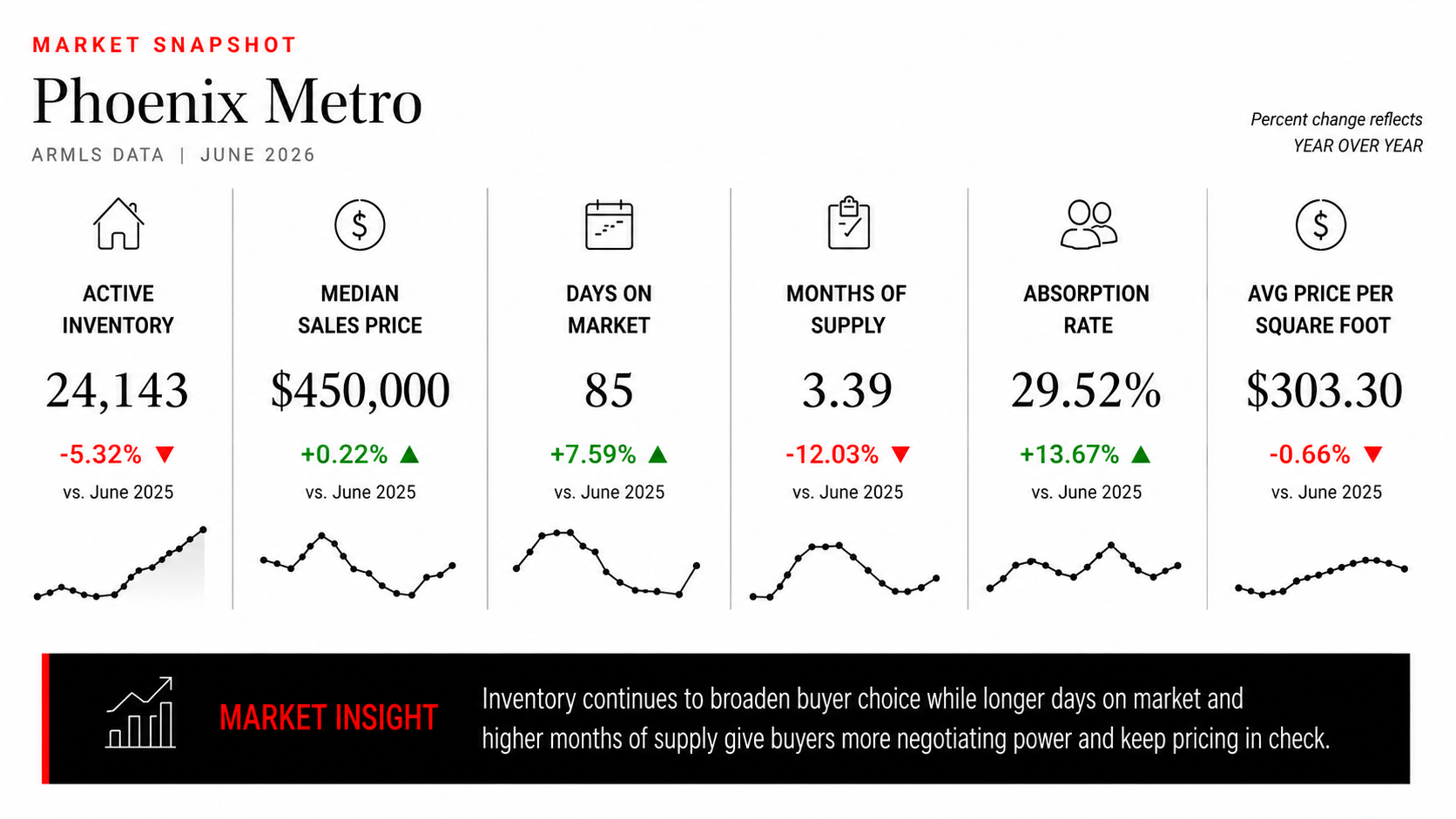
Here's where the local picture splits from the national one. According to ARMLS data for June 2026, active listings across the Phoenix metro, excluding under contract and contingent statuses, sat at 24,143. That's down 4.03% from May and down 5.32% from June of last year.
That's not a small distinction. The national story this year has been rising inventory giving buyers more room to negotiate. Phoenix is telling a different story: available inventory here is shrinking on a year-over-year basis, not growing. Some of the May-to-June drop is seasonal, homes go under contract heading into summer and new sellers pull back once school lets out. But the year-over-year decline suggests something more structural is happening locally, independent of the calendar.
New listings for the month came in at 8,535, down 8.42% from May, though still up 1.67% from a year earlier. Homes moving under contract, tracked as pending and UCB/CCBS status, totaled 7,564, down almost 10% from May but up 5.91% year over year. Put plainly: fewer new sellers came to market in June than in May, but more homes are working their way toward closing than did a year ago.
Months of supply now sits at 3.39, down from 3.85 a year ago. Absorption rate, the share of active inventory getting placed under contract each month, climbed to 29.52%, up from 25.97% a year ago. A rising absorption rate paired with falling supply is usually the setup for a market that firms up, not one that softens.
Pricing: Sellers Are Cutting Faster, But Closed Sales Are Holding
This is the part of the report that deserves the most attention, because two numbers that look like they should move together didn't.
Average new list prices across the Phoenix metro came in at $633,699 in June, down 5.57% from May and up 2.98% from a year ago. Median new list price was $469,000, down 1.26% from May and flat year over year. Sellers are asking for less this month than they were last month, in other words, even with the year-over-year number still slightly positive.
Closed sale prices tell a different story. Average sale price was $614,829, up 1.11% from May and up 4.00% from a year ago. Median sale price came in at $450,000, down slightly from May but up 0.22% year over year. Homes that actually sold in June closed at prices roughly in line with or better than a year ago, even while new listings were coming to market with softer asking prices.
Realtor.com's broader metro data for Phoenix-Mesa-Chandler backs up the softening on the asking side: median list price there was $489,500, down 5.9% year over year, one of the steeper annual declines among the 50 largest U.S. metros. Phoenix also showed up with one of the highest shares of price-reduced listings in the country, 28.7% of active inventory, behind only Denver. That's a meaningful signal. Sellers who listed too aggressively earlier in the year are getting corrected in real time.
Days on market moved a bit slower locally than the national trend suggests. ARMLS put average days on market at 85, up 7.59% from a year ago, with median days on market at 58, up 1.75%. Nationally, the multi-year streak of slower sales just ended. In Phoenix, homes are still taking a bit longer than they did a year ago, though the pace of that slowdown has calmed compared to what the market saw earlier in the cycle.
Read together, this is a market rewarding sellers who price to the current environment and penalizing the ones who don't. A home that lists at last year's number sits. A home that lists at this year's number, even a touch under, tends to move and often closes at or near full value.

What Buyers Should Know Right Now
Buyers active in Scottsdale and Paradise Valley this summer have more room than they had a year ago, but that room is narrower than the national headlines might suggest. Inventory locally is down from last June, not up, so the wide selection some national coverage implies isn't fully showing up here yet.
What is showing up is negotiating leverage on individual listings, particularly ones that have already had a price reduction. With 28.7% of active Phoenix metro listings carrying a price cut, a meaningful share of the market is already signaling seller flexibility before an offer is even written. That's worth checking on any property before assuming the list price is firm.
Mortgage rates sitting near 6.5% for six straight weeks means buyers aren't waiting on a rate drop that hasn't arrived. Homes that fit the budget today are worth acting on rather than shelved for a rate environment that may not materialize this year.
What Sellers Should Know Right Now
The gap between new list prices and closed sale prices is the number to sit with. Average new list prices fell 5.57% from May to June, while average sale prices rose 1.11% over the same period. That gap tells sellers something specific: homes priced accurately at today's market, not last year's, are the ones closing at strong numbers. Homes priced at last year's expectations are the ones sitting and eventually taking a cut anyway.
With absorption rate up to 29.52% and inventory down 5.32% year over year, well-priced listings are moving into a market with less competition than a year ago, not more. That's a favorable setup for a seller who prices correctly from day one rather than testing a high number and adjusting later.
The Luxury Market Perspective
None of the ARMLS or Realtor.com data breaks out Paradise Valley, Old Town Scottsdale, or Arcadia specifically, so any read on those submarkets has to come from what's actually moving on the ground rather than the metro averages. What the metro numbers do confirm is the environment those neighborhoods are operating in: tighter local supply, elevated price-reduction activity metro-wide, and sale prices holding despite softer asking prices.
For custom home construction and architecturally significant properties in North Scottsdale and Paradise Valley, that combination tends to favor sellers who lead with a defensible number backed by comparable sales, rather than an aspirational one built around what a neighboring property asked for last year. Buyers at the upper end of this market are paying attention to price cuts across the board. A listing that opens too high and gets corrected twice reads differently to a serious buyer than one priced right the first time.
Cody Wolfe: Expert Market Perspective
“I spent most of my career as a buyer’s agent before shifting into listings, and this is exactly the kind of month where that background matters. I know what a buyer is thinking when they see a price cut on a listing, because I’ve been the one advising a buyer on whether that cut means real flexibility or just a correction back to where the price should have started. Right now, with almost 29% of active Phoenix metro listings carrying a reduction, buyers are reading those cuts closely, and sellers need to assume they will.
What I’m watching for in my own conversations with sellers is the gap between what a comparable home listed for a year ago and what one is actually closing for today. That gap is real this month, and it’s the reason I push back when a seller wants to open high and “see what happens.” Testing the market with an aspirational number costs time on market, and time on market is the one thing that shows up in every buyer’s negotiation the moment they notice it. A home that sits for 60 days invites a lower offer than one that sits for 15, even if the eventual price is the same.
On the buyer side, I’m telling clients not to wait on rates. Six weeks near 6.5% without much movement either direction tells me this is the environment we’re working in for now, not a temporary plateau before relief. If a home works at today’s number, it’s worth an offer.”
Key Takeaways

Phoenix metro inventory fell 5.32% year over year even as national inventory rose 1.9%, a genuine divergence from what's happening in most of the country. New list prices are getting cut faster locally than almost anywhere else in the top 50 metros, yet closed sale prices are up 4.00% year over year on average. Absorption rate climbed to 29.52%, its highest point in the trailing 12 months shown in this data, while months of supply fell to 3.39. The market is thinner than a year ago and moving faster for anything priced to it.
Final Thoughts
Some of what happened in June is seasonal. New listings always slow heading into the hottest months, and closings compress before school starts back up. But the year-over-year inventory decline in Phoenix, running against the national grain, isn't something the calendar explains on its own. Neither is the gap between falling list prices and rising closed prices. Both point to a market where accurate pricing is being rewarded quickly and everything else is getting corrected in public.
If you're weighing a sale in Scottsdale, Paradise Valley, or McCormick Ranch this summer, or trying to figure out what a specific price reduction actually signals about a listing you're considering, I'm happy to walk through the comparable data with you directly.
FAQs
Q: Is Phoenix housing inventory rising or falling in 2026?
A: Active listings across the Phoenix metro fell 5.32% year over year in June 2026, even as national inventory rose 1.9% over the same period.
Q: Are home prices falling in Phoenix and Scottsdale?
A: New list prices in the Phoenix metro fell 5.57% from May to June 2026, and Realtor.com reported the Phoenix-Mesa-Chandler metro median list price down 5.9% year over year. Closed sale prices, however, rose 4.00% year over year on average.
Q: How long are homes taking to sell in Phoenix in 2026?
A: Average days on market hit 85 in June 2026, up 7.59% year over year, with median days on market at 58, up 1.75% year over year.
Q: Is it a good time to sell a home in Scottsdale in 2026?
A: Absorption rate rose to 29.52% in June 2026 while months of supply fell to 3.39, suggesting accurately priced listings are moving into a market with less competing inventory than a year ago.
Q: How many homes sold in the Phoenix metro in June 2026?
A: 7,128 sold listings, down 3.55% from May but up 7.62% year over year, even as active inventory continued to shrink.
Cody Wolfe is a luxury real estate agent and Partner at The Agency Scottsdale, specializing in Old Town, Paradise Valley, and McCormick Ranch.