Scottsdale and Phoenix Housing Market Update: July 2026
The number that stood out to me in July was not inventory. Active listings across the Phoenix metro barely moved, down 1.6% from June. What moved was how fast those homes were absorbed. Closed sales fell 12% from June, pending contracts dropped more than 10%, and the absorption rate slid from just under 30% to 26.45%. Supply did not flood the market in July. Demand backed off first.
That is a noticeable shift from the conditions I covered in my June 2026 Scottsdale and Phoenix Housing Market Update, when absorption was stronger and months of supply remained closer to its spring level.
The National Housing Market in July
Nationally, list prices fell year over year for the ninth straight month, down 2.4%, though the pace of decline barely changed from June's 2.5% drop. Price cuts ticked up to 20% of active listings, closing the gap with last year's rate after running well below it all spring. New listings pulled back 8.6% from June and were flat compared to a year ago, the first time in 2026 that new supply failed to beat the prior year's pace. Pending sales kept growing year over year for an eighth straight month, but the growth rate has been cooling fast, from 4.1% in May to 1.3% in July.
Time on market nationally actually improved slightly year over year, down one day to 57, even as it lengthened four days from June, which is the normal midsummer drift. Mortgage rates complicated the picture. After easing earlier in the summer, rates climbed back to 2026 highs as the Iran conflict reignited and oil crossed $100 a barrel, reversing some of the relief that had shown up in June. None of this looks like last year's steep summer pullback, but the softening in new listings and the uptick in price cuts are both worth tracking into August.
Phoenix Metro: What Changed in July
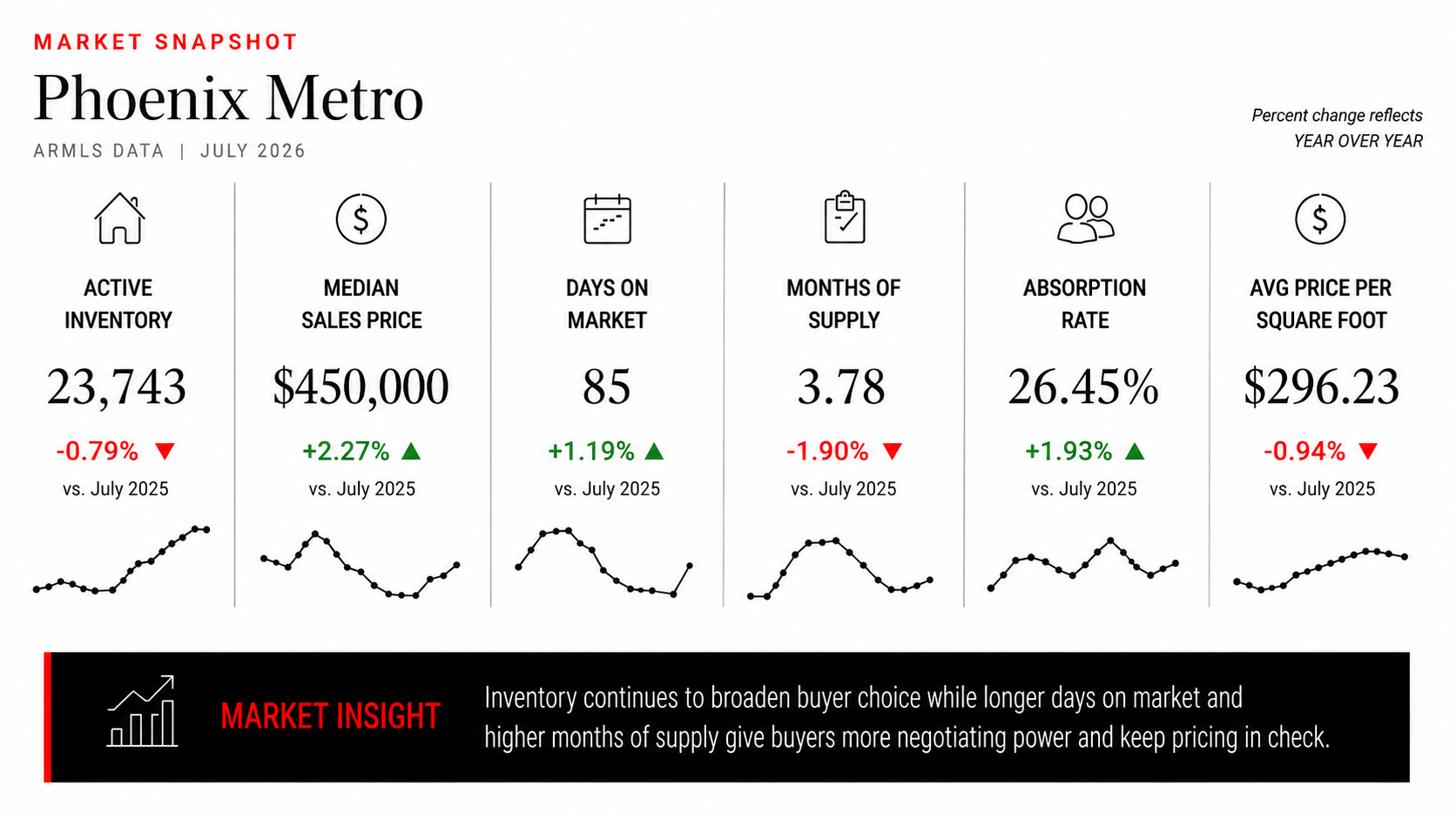
The ARMLS numbers for Phoenix metro tell a more specific version of the national story. Closed sales came in at 6,280 for July, down 12.24% from June's 7,156 but still up 1.13% from July of last year. New listings totaled 8,367, down slightly from June and up 4.39% year over year. Active listings sat at 23,743, essentially flat month over month and down less than one percent from a year ago.
The bigger move was on the contract side. Listings under contract, which combines pending sales with UCB and CCBS status, fell to 6,719, down 10.22% from June and down 2% from July 2025. Months of supply rose to 3.78, up just over 12% from June, while the absorption rate dropped to 26.45% from 29.65%. Both of those figures land close to where they sat a year ago, 3.85 months of supply and a 25.95% absorption rate in July 2025, which tells me the July level itself is not unusual. What is worth watching is the direction. Supply has been building for two straight months after sitting near 3.4 months in May and June, and it is still well below the 5.15 months the metro carried back in January, so this is a market loosening from a tighter spring, not one that has suddenly flipped.
Pricing softened on the new listing side. The median price of homes newly listed in July was $455,000, down 2.99% from June and down slightly from a year ago. Average new list price fell nearly 4% month over month to $608,057. Closed prices told a steadier story. Median sale price held flat at $450,000 from June and is up 2.27% from last July. Average sale price dipped 2.53% month over month but remains up 5.02% year over year. Sellers listing homes in July priced them more conservatively than sellers did in June, while homes that actually closed sold at prices consistent with, or slightly ahead of, a year ago.
Sales Slowed Faster Than Supply Grew
I keep coming back to the gap between the inventory numbers and the activity numbers. If someone only looked at active listings, they would conclude July was a quiet, stable month, since the count barely changed. But sold listings, new listings, and under contract listings all fell month over month, some sharply. That combination, flat supply with softer sales and softer pending activity, is what pushed months of supply up and the absorption rate down. It is a demand story more than a supply story this month.
Days on market backs this up. Median days on market rose to 61, up from 58 in June, a normal seasonal lengthening as the summer heat sets in. But that 61 is still about 3% below where it sat a year ago. Homes are taking a bit longer to sell than they did in June, and still moving somewhat faster than they did in July 2025. Both things can be true at once, and they are.
What the July Numbers Mean for Scottsdale
The ARMLS figures above cover the Phoenix metro as a whole, not Scottsdale specifically, since Scottsdale is not broken out separately in this report. Realtor.com's metro level data for Phoenix-Mesa-Chandler does offer a narrower read, and it points in the same direction with more intensity. Median list price for the metro was down 4.6% year over year in Realtor.com's data, a steeper decline than the national 2.4%. The share of listings with a price cut was 28.1%, well above the 20% national figure. At the same time, median days on market actually improved by three days year over year, a bigger gain than the national one day improvement.
Put together, Phoenix metro sellers cut prices more aggressively than the rest of the country in July, and it appears to be working. Homes are still moving faster than they did last summer despite the larger price adjustments. That is a market correcting price expectations rather than one where demand has disappeared. I would not extend that reading down to every Scottsdale ZIP code without local, submarket level data, but it is consistent with what the ARMLS pricing and absorption numbers show at the metro level.
That distinction matters in neighborhoods such as Arcadia, where limited inventory, lot characteristics, renovation quality, and location can create pricing behavior that looks very different from metro-wide averages.
What Buyers Are Walking Into Right Now
Buyers in the Phoenix metro this month had more room to negotiate than they did in the spring. Months of supply climbed for a second straight month, price cuts on newly listed homes were common enough to notice, and the absorption rate came down from its early summer pace. None of that means homes are sitting unsold. The median home still closed at $450,000, unchanged from June and above last July, and days on market remain shorter than a year ago even with the seasonal uptick. What it does mean is that a buyer who takes their time in August is not obviously working against the market the way they might have been earlier this year when supply was tighter.
If you're buying in Scottsdale or Paradise Valley, here's how I represent buyers, including off-market homes that never reach Zillow.
Considering this part of North Phoenix? Explore my complete guide to the Villages at Aviano for a closer look at the community, amenities, and surrounding lifestyle.
Cody's Current Listings
4317 N 70th St
Villa Adrian
7401 N Scottsdale Rd #26
The Shores at McCormick Ranch
What Sellers Need to Understand About July
The clearest signal for sellers is the difference between what is getting listed and what is getting closed. New list prices dropped nearly 3% at the median from June to July, while closed prices held flat. That gap suggests some sellers adjusted their pricing expectations coming into the market this month, likely in response to the slower absorption and rising supply from June. Homes priced in line with where the market actually is closing, rather than where it was closing three or six months ago, appear to still be finding buyers within a similar timeframe to last year. Sellers who list at a level that assumes spring conditions are the ones most likely to sit and end up needing a reduction later.
Here's how I price and market homes for my sellers.
Scottsdale Luxury Market Perspective

Nationally, the entry point to the luxury tier, the 90th percentile of listing prices, fell to $1,250,750 in July, down 2.7% from a year ago and the 29th straight month of annual decline at that threshold. The narrower high end tier, the top 5%, was down a smaller 1.2%, and the top 1% was down 1.7%. Homes in every one of those tiers sold faster than they did a year ago, which points to a gradual price reset rather than a stalled market at the top end.
Realtor.com's July luxury breakout did not include a Phoenix or Scottsdale specific figure in the markets it highlighted, so I do not have a verified July number for the local luxury threshold to compare against the national one. An earlier report on the Phoenix luxury segment put the entry point in the neighborhood of $1.45 million, with the top 5% starting around $2.5 million, but that figure predates July and I would treat it as directional rather than current. Given the national pattern of price resets paired with faster turnover, and given that Scottsdale and Paradise Valley draw a meaningful share of cash and second home buyers who are less rate sensitive than the broader market, I would expect the local luxury segment to be somewhat more insulated from the metro wide price cutting than the numbers above suggest, but I do not have July data specific enough to state that as fact.
What I Am Watching Going Into August
Three things from this month carry into next. The first is whether months of supply keeps climbing at the same pace or levels off, since two straight months of increases is a trend worth confirming rather than a one month blip. The second is the under contract count, which fell both month over month and year over year in July, a divergence from the national pending sales figure that grew year over year. If that gap persists in August, it says something specific about how the Phoenix metro is behaving relative to the rest of the country. The third is new list pricing. If median new list prices keep dropping the way they did from June to July, that is sellers recalibrating in real time, and it usually shows up in closed prices a month or two later.
None of the July numbers point to a market in trouble. They point to a market where the balance shifted a bit toward buyers after a tighter spring, while pricing at the closing table has held up better than pricing on new listings suggests it might. August will tell us whether that gap closes because buyers step back in, or because sellers keep adjusting to meet where demand actually is.
If you're considering a move in Scottsdale, Paradise Valley, Arcadia, or elsewhere in the Phoenix metro, I'm happy to walk through the numbers for your specific neighborhood or price range. Schedule a call with me here.
Read the August 2026 update to see what happened next.

Cody Wolfe is a real estate broker and Partner at The Agency Scottsdale, representing buyers and sellers across Scottsdale, Paradise Valley, McCormick Ranch, and Arcadia.